
Attachment Styles
Your attachment style determines how you behave in relationships – how you react to conflicts, your approach towards what a relation is and what can trigger your negative behaviour. Pick your way of learning more by clicking on the chosen circle below.

Pictorial Essentials

An article

Podcast
PICTORIAL ESSENTIALS

There are four different styles:
1. SECURE

2. DISMISSIVE AVOIDANT
3. ANXIOUS
4. FEARFUL AVOIDANT

References:
Gonsalves, Kelly. (2021).What Is Your Attachment Style? Attachment Theory, Explained. Retrieved from: https://www.mindbodygreen.com/articles/how-fearful-avoidant-attachment-style-affects-your-sex-life
Joyce Catlett, M.A. Anxiety, Attachment, Self-development. N.d. Retrieved from: https://www.psychalive.org/anxious-avoidant-attachment/
Pelly, Julia. (2019). What Is Avoidant Attachment?. Retrieved from: https://www.healthline.com/health/parenting/avoidant-attachment
TEST
If you wish to learn which style you represent, you can take the test here. The test is for free. Note that, you will have to give them your e-mail address, but after that the results show immediately on the screen and are sent to your mailbox. I recommend the test because I checked it myself. I don’t make a profit on that.
PODCAST
LISTEN ON:


ARTICLE

The Attachment Styles
The theory was founded by psychoanalyst John Bowlby in the 1950s and expanded by Mary Ainsworth. According to the theory, the bond we had with our primary caregivers highly affects our behaviour in relationships during our lifetime. We can distinguish four styles and they determine how we behave and interact with other people, how we react if our romantic relationship turns into something more and how we cope with dispute.
When we have no notion of the attachment styles, and we represent one of the insecure styles, then our reactions can be exaggarated and sort of involuntary. We’re convinced it is us who is in charge of our actions, we believe our reactions are natural and positive, when in fact the unawarness can make us a puppet in the hands of our programmed behaviours.
But as you know, knowledge is power, and if only we realise which style we represent and we learn more about it, then we can liberate ourselves from the clutches of what was formed in the past.
A real life example

Let me give you a real life example. A few years ago, on a rainy autumn day, my workmate and I went out for a drink. I didn’t know her well at that time and so I assumed our meeting would be short but we kept talking cheerfully for a long time. At some point, however, as my collegue had had a few drinks, her face clouded and she opened up about her unusual relationship, her voice breaking. She told me about a guy who had courted her and once she liked him back, he got distant. Sadly, for the next three years they remained in a push-pull dynamic; he didn’t want to be officially with her, but didn’t want to give up on her either; she couldn’t stand his behaviour and yet she couldn’t let go of the relationship. And so they stayed together, him being avoidant, her being hurt and apprehensive about losing him for good.
That evening she told me none of her friends could help her nor shed some light on why her lover kept acting like that. That one sentence saddened me even more… ‘If only the knowledge of attachment styles was more widespread,’ I thought. I leaned over the table and gently said, ‘This looks like an unbalanced relationship between a Dismissive Avoidant Style and Anxious Style.’
Unsurprisingly, my workmate was clueless as to what that was. But that was years ago. Since that day my friend has eagerly educated herself in that field and she’s made huge progess, she’s no longer a slave of programmed behaviours, she’s aware of many processes and she’s heading a positive direction. We can change.
We can change the course of our life.
Now, let’s introduce you to the four attachment styles (the nomenclature may differ):
The description below is highly simplified for the sake of making the concept more approachable. However, please bear in mind that the attachment theory is complex and needs further reading. The references and useful links to different articles and videos are given at the end of this article.
Number one

Secured Attachment Style
The most popular one, comprising roughly 56% of population.
- self-image is positive
- easy to connect with others
- not afraid of intimacy and sharing deep thoughts
- not feel panicked when their partner needs space
- can trust others and be trusted
As you can guess, Secured Style is the organized style.
How it develops (in a nutshell):
Note that the description below relates to at least one of the parents or primary caregivers.
Sense of security: YES
Punitive behaviour for showing emotions: NO
Consistency: YES
Feeling understood: YES
Supportive behaviour: YES
Satisfied needs: YES
Number two
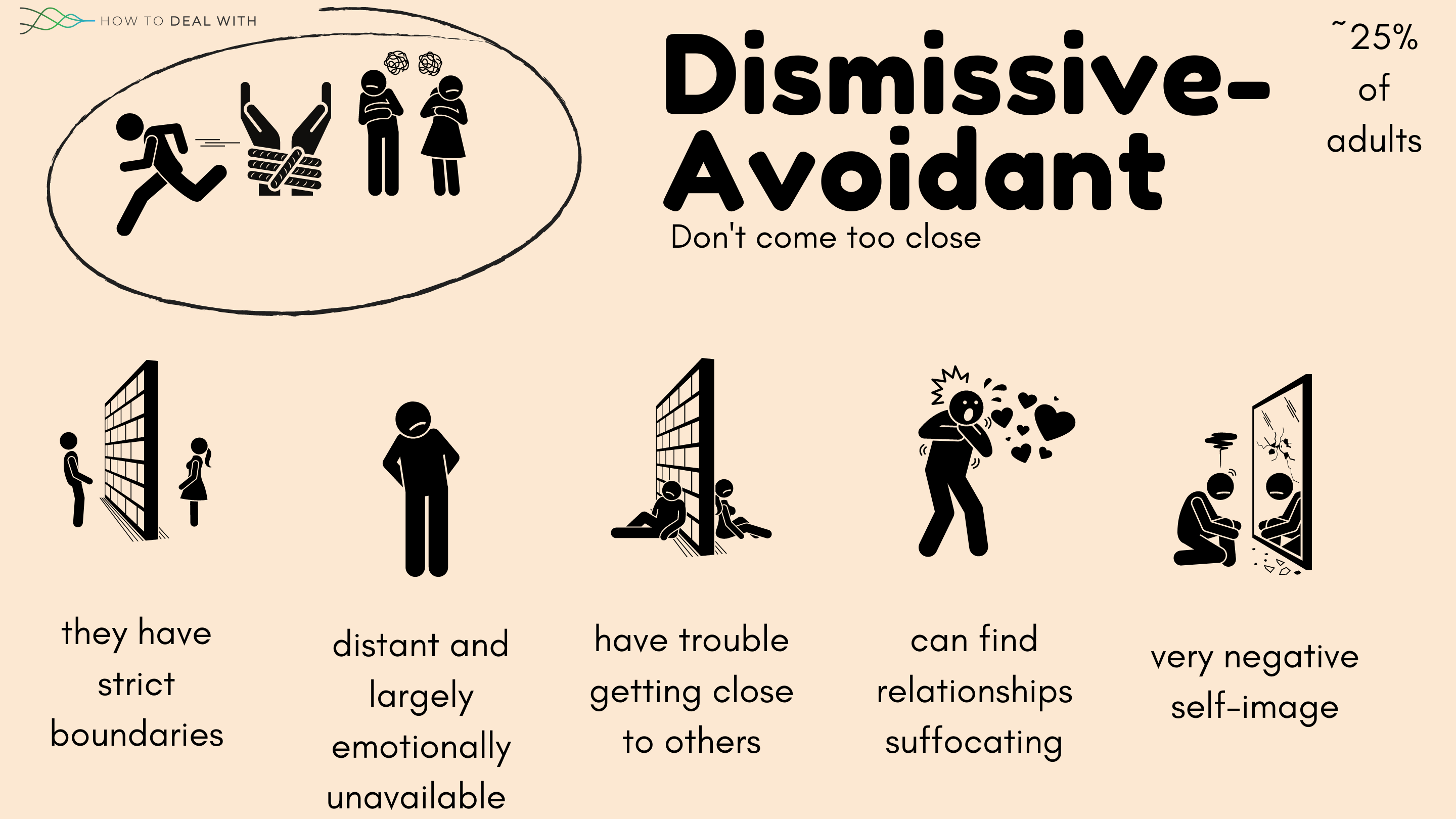
Dismissive Avoidant Attachment Style
- they have strict boundaries
- very negative self-image
- have trouble getting close to others
- can find relationships suffocating
- distant and largely emotionally unavailable
How it develops (in a nutshell):
Note that the description below relates to at least one of the parents or primary caregivers.
Sense of security: NO
Punitive behaviour for showing emotions: YES
Feeling understood: NO, criticism
Satisfied needs: with delay
Number Three
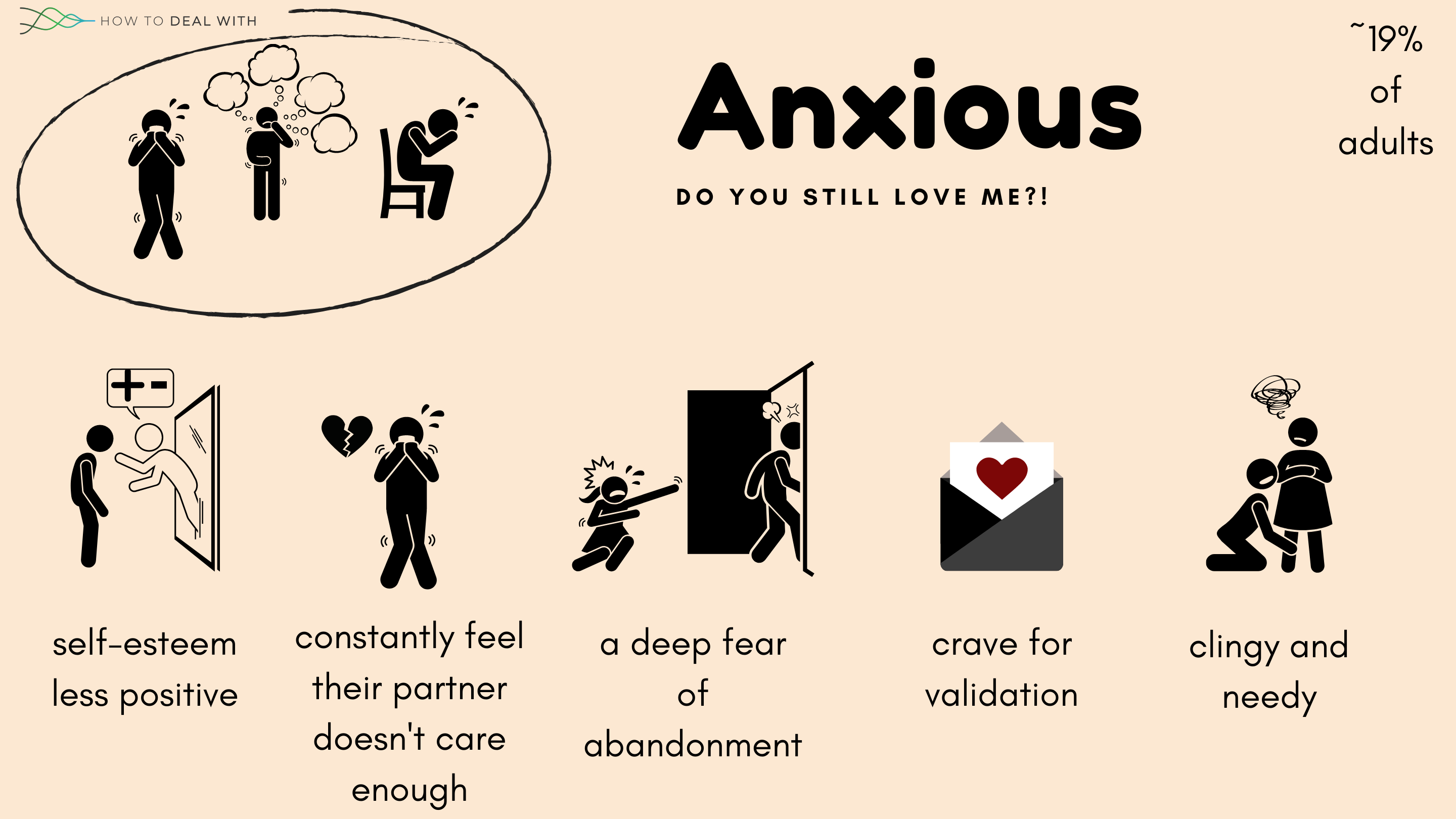
Anxious Attachment Style
- self-esteem less positive
- clingy and needy
- a deep fear of abandonment
- crave for validation
- constantly feel their partner doesn’t care enough
How it develops (in a nutshell):
Note that the description below relates to at least one of the parents or primary caregivers.
Sense of security: NO
Punitive behaviour for showing emotions: NO
Consistency: NO
Feeling understood: most of the time
Supportive behaviour: YES
Satisfied needs: mostly yes
Number Four
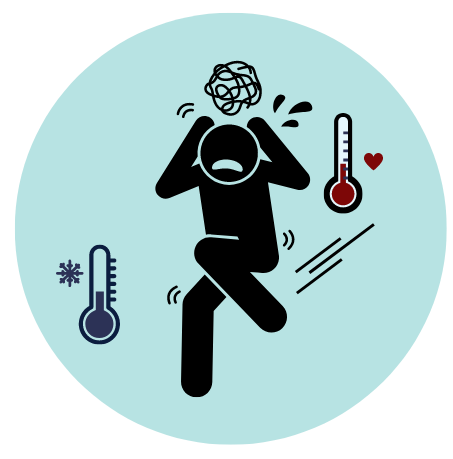
Fearful Avoidant
- fluctuating self-esteem
- try not to show their true emotions
- one moment warm and caring, the next moment cold and indifferent
- want closeness but crave for space as well
- have trust issues
How it develops (in a nutshell):
Note that the description below relates to at least one of the parents or primary caregivers not necessarily to both of them.
Sense of security: one of the parents can perform a terrifying behaviour
Punitive behaviour for showing emotions: YES
Feeling understood: NO
Satisfied needs: sometimes yes
TEST
You can take the test here. The test is for free. Note that, you will have to give them your e-mail address, but after that the results show immediately on the screen and are sent to your mailbox. I recommend the test because I checked it myself. I don’t make a profit on that.

Wonderful videos on the attachment styles:
References:
Cherry, Kendra. (2022). The Different Types of Attachment Styles. Retrieved from: https://www.verywellmind.com/attachment-styles-2795344
Gonsalves, Kelly. (2021).What Is Your Attachment Style? Attachment Theory, Explained. Retrieved from: https://www.mindbodygreen.com/articles/how-fearful-avoidant-attachment-style-affects-your-sex-life
Joyce Catlett, M.A. Anxiety, Attachment, Self-development. N.d. Retrieved from: https://www.psychalive.org/anxious-avoidant-attachment/
Pelly, Julia. (2019). What Is Avoidant Attachment?. Retrieved from: https://www.healthline.com/health/parenting/avoidant-attachment
Go to Topic Map