
Have you ever been frustrated with someone’s behaviour or with your own one? Have you ever wondered why someone is the way he is? Or perhaps you’ve felt misunderstood? How about discovering 16 personalities then? Knowing your personality type opens plenty of doors that have been closed.
Pick the way you prefer to learn more:

Pictorial Essentials

An article

A podcast
PICTORIAL ESSENTIALS
Style update! This PDF follows our old design, but don’t worry—the quality content inside remains timeless.
Resources:
Cherry, Kendra. (2021). An Overview of the Myers-Briggs Type Indicator. Retrieved from: https://www.verywellmind.com/the-myers-briggs-type-indicator-2795583
Personality Types. Retrieved from: https://www.16personalities.com/personality-types
Which type are you?
You can find the link to the personality test below. The test is for free, it will take you around 10 minutes. Please, note that I recommend this particular test purely because I checked it myself, I don’t make a profit on that.
PODCAST
LISTEN ON:


ARTICLE
Why is it so great to learn more about your personality type?
I guess we’ve all experienced that – we look at someone and we think “I don’t get you at all.” Or we catch ourselves mulling over why our partner is like “this” but cannot be like “that”? Or perhaps you know this confusing situation when you have two good friends but they don’t get on well?
Table of contents
- Brief description
- The tricky friendship thing
- Romantic relationship – get rid of frustration
- Career choice
- The test
Let’s have a look at the reasons why the Myer-Briggs Type Indicator (MBTI) is such a wonderful thing.
You can discover pictorial descriptions of each personality type here, but at first let me give you their names:
Analysts: Architect (INTJ), Thinker (INTP), Commander (ENTJ), Debater (ENTP)
Diplomats: Advocate (INFJ), Mediator (INFP), Protagonist (ENFJ), Campaigner (ENFP)
Sentinels: Inspector (ISTJ), Defender (ISFJ), Executive (ESTJ), Caregiver (ESFJ)
Explorers: Virtuoso (ISTP), Adventurer (ISFP), Persuader (ESTP), Animator (ESFP)
I – Introvert E – extravert
S – Observant N – Intuitive
T – Thinking F – Feeling
P – Perceiving J – Judging
The tricky friendship thing
You like A and B but they hate each other, which is beyond you. You want to know why your friends don’t get on well?
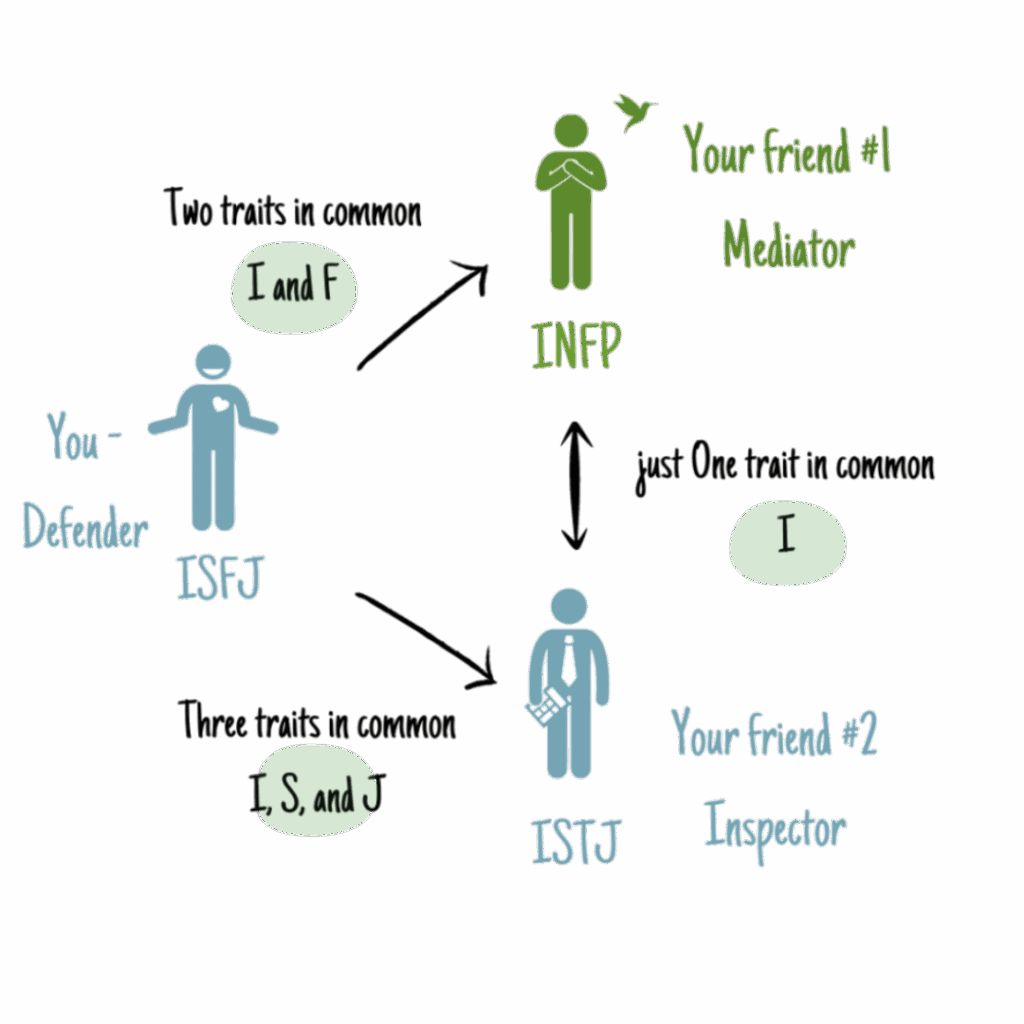
Each personality type can be represented by the combination of 4 different “core” traits. It’s very good to have at least 2 traits in common – then you have enough things in common to get on well, but enough differences between each other to sustain a healthy balance. So then, when you’re a Defender (ISFJ), for example, and your two best friends are an Inspector (ISTJ) and a Mediator (INFP), then as you can see, you share 3 traits with an Inspector – you’re both Introverts (I), you focus on facts (S) and you are organised (J). With a Mediator, you share 2 traits – you’re both Introverts (I) and you prefer following your feelings (F) to following your sense. That’s why you get on fine with each of your pals.
But what do your friends have in common? Well, not much… they’re actually markedly different, apart from one thing – they’re both Introverts, but it’s really not enough. Whoever is an Introvert here, they know that as an Introvert you do not hurry to talk to somebody unless you really like that person. By this logic, when two Introverts don’t have anything else in common, there’s no energy to talk. When it comes to sharing 1 trait only, it’s better to have a different one, it’s simply easier to become friends.
Preventing drama
Also, even though two same personality types will always differ, still there are certain behaviours and characteristics that are easily foreseen, and knowing them can prevent drama. For instance, let’s say that you have a problem…
If you’re looking for compassion and someone to pet your head, then go to an xxFx personality (a person with a Feeling trait).
If you go with the same expectations to an xxTx personality (a Thinking trait), then most likely you will end up disappointed or even frustrated, calling your friend heartless and cold.
Conversely, if you need a firm hand then xxTx personalities are the right choice. And let’s be honest, both approaches can make a good solution, depending on a situation.
Romantic relationship – get rid of frustration
Let’s analyse one story example. We have a couple – Ellen, a Protagonist (ENFJ), and her husband Brian, a Defender (ISFJ). I’d like to focus on one particular trait of Protagonists that caused plenty of confusion and frustration in Ellen’s life. Protagonists tend to stand up and defend other people when they feel that’s the right thing to do (I guess that’s why the usual graphic representation of a Protagonist is a man with a sword).
Anyhow, in Ellen’s life, no one has defended her – whenever someone was against her, she had to deal with that by herself. No matter if next to her there were her friends, family members, or her partner. Ellen couldn’t figure out why they weren’t able to do for her what she’d done for them many times before. Ellen’s frustration and annoyance was especially intense when it was her partner who wasn’t able to speak up for her. But then – knowledge is power. When she learned more about personality types, she finally understood – speaking up and defending others was specifically a trait of Protagonists. It’s not like other personality types are unable to do that, it’s simply more natural and instinctive for Protagonists.
Positive consequences
What were the consequences of Ellen’s discovery? Instead of bending her partner’s ear over why he couldn’t speak up for her, she stopped being annoyed with him. Normally, we get irked if something is unfair, when we don’t understand something – but when we finally do, our frustration subdues significantly or vanishes entirely. Plus, we can focus on the unique traits of our partner – the strengths that come in with our partner’s personality type. In Ellen’s case (since her partner is a Defender), she can enjoy his caring nature, a shoulder to cry on, his eye for details, and his ability to highlight the nuts and bolts of things whenever they escaped her.
Another example: a friend of mine, Kate, is a Commander (ENTJ) – for those who’re not familiar with this personality type – Commanders like commanding 😉 they prefer following their reason instead of their feelings, and they are excellent strategic thinkers. One day, she complained to me that she’d like her partner to make decisions at last, that she was fed up with making all the decisions. The thing is – many personality types might find it challenging to be partners of Commanders due to their commanding nature, but interestingly, her husband, as an Adventurer (ISFP), likes to have somebody decisive by his side. Adventurers, though described as strongly desiring personal space, have a thing for people who take the lead. Now, can you see it? My friend got frustrated with her partner over something that actually caused him to be with her and stick with her in the first place.
Having said that, I’d like to point out that all personalities are wonderful and no example on this website is to deem any personality as superior to others.
Finally it will become clearer to you what kind of career you would be happy in

We all need money – that’s obvious – we need to pay rent and pay for the food, unless you desire to be a hermit living in the middle of nowhere, of course. But those who don’t, may one day wake up, just like me, and think of all possible careers and start having doubts as to whether their career choice was the right one. To me, it was a bit spine-chilling.
My family members are bankers, restaurateurs, project managers… Some of my friends are teachers, others journalists and photographers… and before I discovered the 16 personalities, I’d been seriously afraid that I was wasting both my life and my time.
I’d experimented with different jobs: I worked as a photographer, I did some dubbing, I worked as a Guest Relation in a 5-star hotel, but my longest career has been as a teacher for adults. And it’s been fun being a teacher. But there’s always been something missing, and at some point I even got frustrated with myself. “Why can’t I just be satisfied with my job when it’s actually a good one?” – this is the question I kept asking myself.
Our job as our passion
You know, I’m aware of the fact that some people believe that work should be work, it’s not supposed to be pleasant. But I think otherwise. I’m more than convinced that our job can be our passion as well. The thing is though, we’re constantly bombarded with so many options and so many different opinions that at some point we might lose the sight of what we’re meant to be doing, and we just pursue what we think we have to be doing.
But guess what, knowing your personality type, can truly bring you a new perspective. So here’s what I found about myself:
Apparently, as a Protagonist I love helping people. When I first read this, I winced. Why? Because I’d never perceived myself as a helpful person in the first place. I’m the last person to help you with dirty dishes or sweeping the floor, seriously (not that I’m proud of that, I’m not). And that was my definition of being helpful and that was my mistake. Because there are different definitions of being helpful. My closest ones opened my eyes to certain facts – whenever you have a dream, I’ll be the first one to genuinely support you and cheer you on. If you need help making your dreams come true – I’ll gladly help you.
Now, thank you, my dear friends, for making me realise that; yes, actually I do like helping people.
Shedding some light
So you see, it appears that I’ll be the happiest if I help other people. But by saying “help” I mean showing you that whatever you dream of, you can do it, you can make your life better, you can bring meaning to your days, and that limits are only in our heads. That’s why I created this website, and that’s why so many things here are for free – because I really want to make positive psychology more approachable – it can really make a difference.
Having said that, getting into the details of your personality type can shed some light on what kind of career would truly satisfy you – and let’s be honest – work is a huge chunk of one’s life. So it’s worth going for it.
If you know something about my personality type (ENFJ), you might stop and think – “Hey, but you’ve been a teacher, and apparently being a teacher is a good job idea for you, and yet you were dissatisfied.” And I will say “Yes, I was. But not entirely, I didn’t hate my job, I really liked it. The thing is I knew I could do more, I knew something was missing. And then I realised what that was.
Knowledge is power.

Go to Description – Personality Types to learn more about 16 personalities.
Check which type you are: Personality Test
The test is for free, it will take you around 10 minutes. Please, note that I recommend this particular test purely because I checked it myself, I don’t make a profit on that.